

Every year around this time, small business coverage runs the same Hispanic Heritage Month story: hard work, grit, a photo of someone standing proudly in front of the shop they built from nothing. All of it true. None of it new.
Here's what doesn't usually make the cut: According to the 2026 Business Ownership Report from Intuit QuickBooks, Hispanic business owners report the strongest commitment to their businesses of anyone in the data, despite reporting more financial risk and more pressure than almost any other group surveyed. Nearly six in ten (57%) describe themselves as fully "locked in" to their business for the long haul.
That same conviction carries into how Hispanic business owners see the future. Fully 61% expect to be running their business with AI as a core daily tool within five years, more than any other group surveyed.
None of that erases the harder parts of the story. Hispanic business owners take on more personal financial risk than nearly every other group surveyed, and they carry a heavier sense of responsibility to represent their communities well.
But put the risk and the forward-thinking side by side, and a sharper picture emerges. This isn't a group weighed down by hardship, or one coasting on easy confidence. It's both at once: more risk, more pressure, and the highest long-term commitment rate in the data.
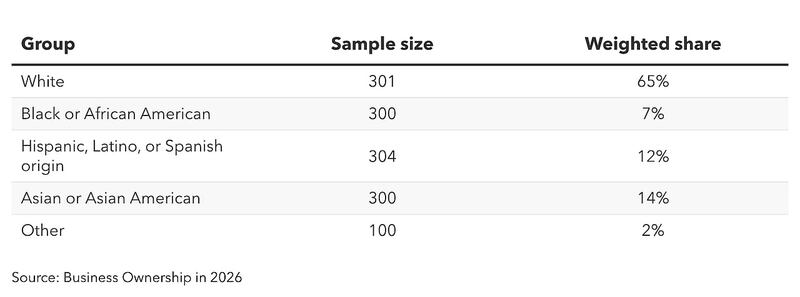
The numbers come from the 2026 Business Ownership Report, which polled 1,305 U.S. business owners, including 304 who identify as Hispanic, Latino, or of Spanish origin.
Hispanic entrepreneurs are a younger, actively scaling wave of ownership
Hispanic business owners skew younger than the overall population of business owners surveyed. Three-quarters (75%) are Millennials or younger, compared with 63% overall, and only 2% are Baby Boomers, compared with 10% overall. This isn't a group easing toward retirement while holding onto a legacy business. It's a group still building. Many are early in that build, too: 52% say their business started as a side hustle or hobby that grew into something bigger, slightly above the overall rate (49%).

Intuit QuickBooks
And they're less likely to work solo: just 22% run their business alone, compared with 31% of white business owners. Nearly a third (33%) run businesses with 10 to 49 employees, among the highest share of any group in the survey—more evidence that this is a population actively scaling, and carrying some big responsibilities.
Younger owners building fast-growing businesses may face more financial risk along the way. For Hispanic business owners, the data backs that up.
How Hispanic business owners are betting on themselves financially
When the business needs cash, Hispanic business owners are more likely to reach into their own pockets first. Nearly 1 in 4 (24%) have tapped retirement savings to keep things running. Another 28% have borrowed money from family or friends, while 26% have sold personal assets. Each of those figures runs well above what white business owners report. The flip side tells the same story. Only 17% of Hispanic business owners say they haven't taken a real financial risk for the business, compared with 26% overall.

Intuit QuickBooks
That risk shows up in smaller, repeated ways as well. More than half (55%) of Hispanic business owners have skipped or reduced their own salary one to five times in the past year just to make payroll or pay the bills, while another 7% have done it six times or more. Only 38% say they have never resorted to skipping or reducing their own salary, compared to 46% overall and 50% of white business owners.
This group is also more likely to make sacrifices in their personal life (like sleep, physical or mental health, or time with family) or miss important personal milestones for the sake of their business. Less than 1 in 10 (9%) say they haven't sacrificed any aspects of their personal life for the business—the lowest share of any group in the survey, by a wide margin. And only 30% say they’ve never missed a personal milestone.

Intuit QuickBooks
None of that risk tolerance makes the anxiety go away. If anything, it shows up every day in how these owners think about cash flow.
How cash flow weighs on Hispanic business owners every day
Hispanic business owners are far more likely to say cash flow worry follows them around all week. Roughly 1 in 3 (34%) say it's "constantly on my mind," compared with 19% of business owners overall. Only 3% say they never worry about cash flow, compared with 10% overall.
That worry isn't abstract. The standard wait for funds to clear (the 1-3 day lag for ACH transfers or credit card payments) affects Hispanic business owners more than most, according to the survey. More than half (62%) report ongoing cash flow gaps while they wait on payments, and 15% of those call the impact critical—both notably higher than what white and other business owners report. To close that gap, 71% of Hispanic business owners have paid an extra fee for instant transfer or faster deposit just to get their own money sooner, compared with 59% overall.
Late payments carry more weight, too. Only 47% of Hispanic business owners say they've never struggled to make payroll or pay a bill because a payment came in late, compared with 61% overall. When cash flow is this unpredictable, a loan or line of credit is exactly the kind of cushion that would help. But Hispanic business owners are less likely to even try: 43% have avoided applying for a business loan altogether because they assumed they'd be denied, compared with 35% overall.

Intuit QuickBooks
Without that outside cushion, the pressure has to land somewhere. For a lot of Hispanic business owners, it lands on their own values: 73% say they've felt pressured to make a financial or operational decision that conflicted with their personal values, compared with 59% overall and 57% of white business owners.
Put together, Hispanic business owners report managing more financial exposure with fewer reported external financing cushions, and paying (literally) to close the gap.
Why representation weighs so heavily on Hispanic business owners
For many Hispanic business owners, success isn't just personal. Two in three (66%) say they feel a real responsibility to prove that people from their background can succeed as entrepreneurs, compared with 49% of white business owners—a 17-point gap. More than half (53%) also say they feel pressure to code-switch, changing how they speak, dress, or act to be taken seriously by investors, lenders, or clients.
That pressure shows up in action, not just feeling. Fully 57% of Hispanic business owners have taken concrete steps to guard against bias in their business, compared with just 33% of white business owners. That includes Hispanic business owners avoiding race, gender, or age references in marketing (27% vs. 14% of white business owners) and modifying their dress or style to sidestep stereotypes (20% vs. 11%).

Intuit QuickBooks
The stakes feel different, too. When asked what they'd fear most if their business failed today, 45% of Hispanic business owners point to letting down their family or community, not just financial loss, compared with 32% of white business owners. And 59% say it's important that their business creates career paths for people from similar backgrounds, compared with 42% of white business owners.

Intuit QuickBooks
Running a business, for a lot of Hispanic business owners, means carrying more than their own name. And that same forward-looking instinct shows up in how they think about technology, too.
Hispanic business owners are leaning into AI, not away from it
More than half (55%) of Hispanic business owners expect to be running their business with AI as a core daily tool within five years, more than any other group surveyed. Another 6% say AI will drive the majority of their business operations. That same forward-leaning instinct shows up everywhere else they were asked about AI—Hispanic business owners are planning for a more AI-enabled business, not just letting it happen.

Intuit QuickBooks
From the books to the busy work, to developing marketing campaigns and doing complex analysis, Hispanic business owners are leaning on AI to streamline and improve operations across multiple business functions surveyed. Only 10% say they'd still want a human handling every part of their job, even if a trusted AI assistant could do it with complete accuracy, the lowest share of any group.
That confidence in technology extends to how they see the competitive landscape overall: AI as a way to close the gap with bigger competitors, not widen it. Four in 10 (42%) Hispanic business owners believe AI helps small businesses compete with larger companies, compared with just 30% of white business owners.
The flip side of that optimism is urgency. Fully 44% of Hispanic business owners are concerned their business will fall behind competitors if they don't keep up with AI, and only 12% write off that risk entirely, less than half the rate of white business owners (24%). This isn't a group waiting to see how AI shakes out. They feel the clock ticking, and they're already moving.
That mix, leading the curve while feeling the pressure to keep leading it, carries into the next part of the story: even with more on their plate than most groups, Hispanic business owners keep betting on where things are headed.
Despite the pressure, Hispanic business owners are the most committed
Every stat so far points to a group carrying more financial risk and more pressure than most, and still showing up anyway. When asked how that stress is shaping their plans for the future, Hispanic business owners are the most likely of any group to say they're staying the course. Nearly 6 in 10 (57%) describe themselves as "locked in," fully committed to their business for the long haul, compared with 51% overall, the highest share of any group surveyed.

Intuit QuickBooks
That commitment extends beyond their own business. A third (32%) of Hispanic business owners plan to use their business to mentor up-and-coming entrepreneurs over the next five years, significantly more than white business owners (24%) and the overall sample (27%).
Carrying more hasn't made Hispanic business owners more likely to walk away. If anything, it's made them more likely to stay, and to make sure someone else gets the same shot they did.
About this data
In December 2025, Intuit QuickBooks surveyed 1,305 U.S. business owners, all sole owners, co-owners, or co-founders of businesses with 0 to 250 employees. To make reliable comparisons across racial and ethnic groups possible, the survey oversampled Black, Hispanic, and Asian business owners, then weighted the results to reflect the actual demographic makeup of U.S. business owners, based on U.S. Census Bureau data.
Intuit QuickBooks
Differences between racial and ethnic groups called out in this piece are statistically significant at the 95% confidence level. For the full sample, the estimated margin of error is ±2.7 percentage points at the 95% confidence level. Percentages are rounded to the nearest whole number and may not always add up to 100%.
This story was produced by Intuit QuickBooks and reviewed and distributed by Stacker.