


Almost every year, Black Friday sets a new record, and every year the headline number gets bigger. In 2025, U.S. shoppers spent $11.8 billion online in a single day, up from $1.93 billion in 2013. On the surface, that looks like proof of a confident, healthy consumer. But the headline number alone misleads more than it illuminates.
Look underneath and the picture changes. Transaction volumes barely moved, while average selling prices rose 8% in the U.S. versus 5% globally, a gap tied directly to tariffs. The top 10% of earners now account for roughly 48% of all consumer spending, 30% of shoppers planned to spend less, and Buy Now, Pay Later topped $1 billion in a single day on Cyber Monday. A record Black Friday and a strained household budget can both be true at once.
Here, Plus500 breaks down what Black Friday spending really reveals about the U.S. economy: how much of the growth is price versus volume, who is driving it, what BNPL says about financial stress, and why the one-day stampede is no longer the event it used to be.
From $1.93 billion to $11.8 billion: The arc of a retail era
Black Friday's transformation into a closely-watched economic data event mirrors the transformation of the U.S. economy itself over the past two decades.
In 2013, U.S. consumers spent $1.93 billion online on Black Friday, a then-remarkable figure that signaled e-commerce had gone mainstream. By 2024, that number reached $10.8 billion, and in 2025 it hit a new record of $11.8 billion, a 511% increase over eleven years. Total U.S. Black Friday retail (online plus in-store) crossed $20 billion for the first time in 2024.
That growth curve, however, has never been smooth, and the bumps reveal as much as the trend.
The historical record, year by year
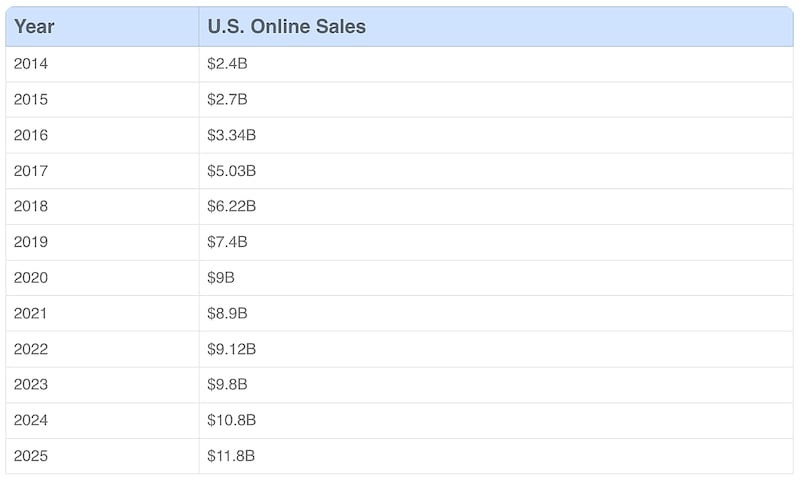
Plus500
Headline records with asterisks
Recent Black Friday seasons have consistently set records in dollar terms: $11.8 billion online in 2025, a 9.1% year-over-year increase; total U.S. retail sales (excluding autos) up 4.1% per Mastercard SpendingPulse.
But economists read the underlying data differently.
The first tension: spending grows in dollars, not in goods. Neil Saunders, managing director of GlobalData Retail, told Newsweek that while Black Friday value grew around 3.1%, transaction volumes rose by only 0.2%, meaning the increase was almost entirely price, not volume. "Consumers dug deep on Black Friday, but they were selective in their spending and largely stuck to budgets. The new reality is that dollars stretch less far than they once did, and consumers have adjusted to that."
Salesforce data showed average online selling prices in the U.S. rose 8% year-over-year in 2025 versus 5% globally. Caila Schwartz, Salesforce's director of consumer insights, explained the gap: "The first is absolutely the impact of tariffs, especially on those discretionary categories where we've seen a lot of growth in selling price. The other is the fact that we're seeing a much stronger higher-income earner than average-income earner, evidenced by the strength in the luxury category." The Tax Foundation estimated tariffs added roughly 4.9 percentage points to retail prices heading into the 2025 holiday season.
The structural shift: Who is actually spending
The most consequential long-run trend in Black Friday data is not in the total, it's in the composition.
The richest 10% of Americans account for roughly 48% of all U.S. consumer spending, up from around 35% in the mid-1990s, according to Moody's Analytics. Categories like furniture and luxury goods consistently lead Black Friday gains in recent years precisely because upper-income households, buoyed by strong equity markets, remain insulated from the economic anxiety affecting most of the country.
Meanwhile, a Bankrate survey found 30% of consumers planned to spend less on the holiday season, and 43% planned to spend the same. One way to reconcile those expectations with record aggregate spending is the disproportionate weight affluent consumers carry in total figures.
Joanne Hsu, director of consumer surveys at the University of Michigan, explained the dynamic directly: "The lion's share of aggregate spending is generated by high-income, high-wealth consumers. These consumers are supported by strong stock markets and may be more willing to spend, even as lower-income, lower-wealth consumers tend to pull back."
Retail analyst Neil Saunders framed the retail consequence: "Growth is mostly being driven by middle, and higher-income households and is not a broad brush. Muted volume growth creates polarization between winners and losers and there is not enough growth to satisfy all retailers."
This K-shaped dynamic is not unique to any single year, it has been building since at least 2018. Black Friday aggregate data now makes it visible in ways that monthly retail reports often obscure, because the single-day concentration of spending strips away the noise.
Buy now, pay later: The stress gauge
One of the clearest signals of household financial strain embedded in Black Friday data is the rise of Buy Now, Pay Later. Adobe forecast $761.8 million in BNPL spending on Black Friday 2025 alone, with Cyber Monday exceeding $1 billion in BNPL spending in a single day. Total annual BNPL volume in the U.S. reached an estimated $70 billion in 2025, according to the Federal Reserve Bank of Richmond, roughly 1.1% of total credit card spending, up approximately 20% per year in real terms from 2021.
BNPL usage has grown in tandem with Black Friday's nominal records, functioning as a pressure valve that allows consumers to participate in spending events they could not otherwise afford outright. The Federal Reserve Bank of Richmond concluded in early 2026 that "the impact of BNPL on financial stability appears limited at present" and found "no clear evidence of elevated stress to date," but also noted that BNPL users tend to carry higher balances on other unsecured credit products, and that "the welfare effects of BNPL appear mixed."
The structural dependence on deferred payment as a prerequisite for participation is itself a measure of how thin many household budgets have become.
The behavioral discipline shift
Perhaps the clearest structural change across the multi-year arc: The nature of Black Friday shopping itself has changed permanently.
The shift from in-store stampedes to planned, price-comparison-driven online purchasing has been building since at least 2017. In-store foot traffic declined 3.2% year-over-year in 2024 and 5.3% in 2025. Mobile shopping has grown from a minority of online sales in 2017 to 55% of all online purchases by 2024.
Retailer behavior has adapted accordingly. Discounts now begin in October, promotional windows stretch across November, and the urgency of a single 24-hour window has been deliberately diluted. WalletHub data shows the average Black Friday discount among major retailers has actually compressed slightly, from 40.2% in 2015 to 38.2% in 2024, as retailers spread promotions wider rather than deeper.
The result is a consumer who shops Black Friday the way they shop any other sale: with price comparison tools open, returning items freely, and spreading purchases across a multi-week window. The cultural event is largely symbolic at this point. The economic signal, however, remains real.
This story was produced by Plus500 and reviewed and distributed by Stacker.